Shopify's new App Store rules: ten installs before your next app
On 10 November 2026 Shopify published new rules for getting an app onto the Shopify App Store, under the heading "build, grow, then expand". The short version: a developer has to show that merchants use the apps they already have before listing another one. We build Shopify apps, so we read the announcement, the documentation behind it and the developer forum thread. Here is what changed, what is still unclear, and what it means if you are a merchant or are planning an app.
What changed
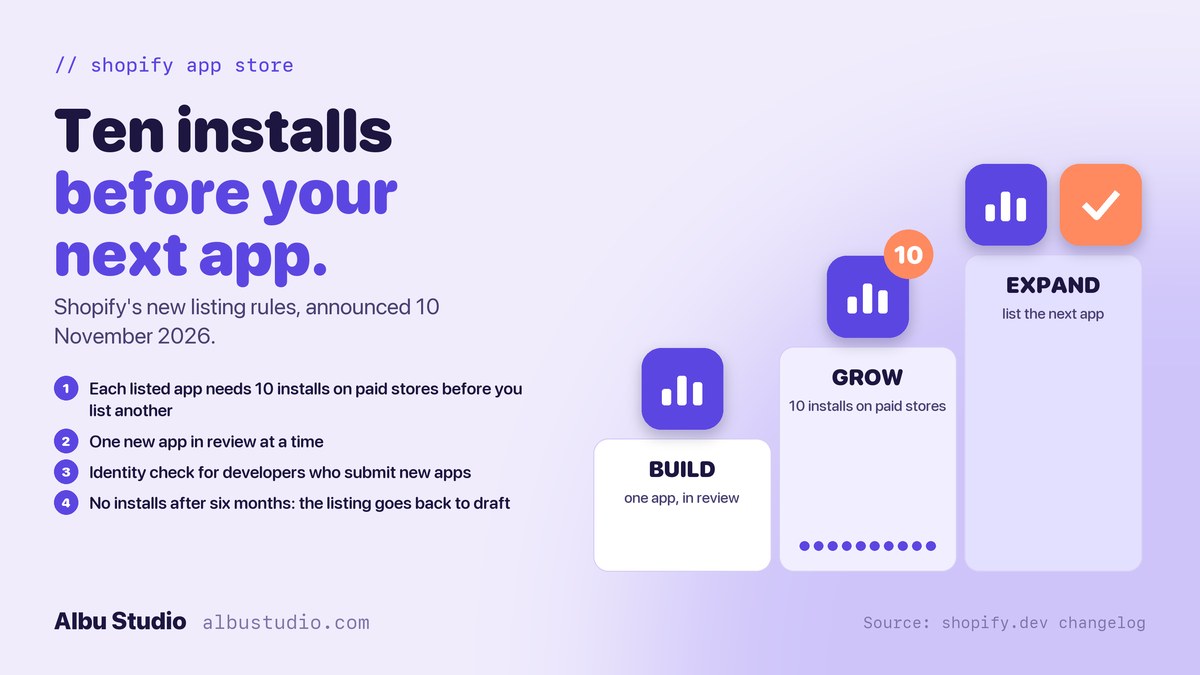
- Ten installs per app before another listing. In Shopify's words, each of your existing apps must have at least 10 installs on full-priced Shopify stores before you can list an additional app. The documentation explains that development stores and stores on a free trial do not count, and that the rule does not apply if you have no published apps yet.
- One new app in review at a time. The documentation adds that a developer can have only one never-published app in the review queue.
- Longer waits after repeated rejections. A submission that keeps coming back without the reviewer's points fixed gets a cooldown, and each cooldown is longer than the one before. Shopify has not published the lengths.
- Identity verification. The changelog says it is now a required step for developers who submit new apps; the forum announcement says it will "soon" be required. Either way, it is coming.
- Unused apps leave the store. The changelog says apps with zero installs after six months are automatically removed. The documentation is more precise: an app published for six months with no active installs is moved back to draft, not deleted, and there is a 90-day wait before it can be submitted again.
Shopify says the rules apply to new submissions, resubmissions and listed apps from the day of the announcement. Updates to an app that is already published are not affected, and neither are apps that already meet the threshold.
Why Shopify is doing it
The stated reason is trust: merchants should be able to install an app knowing that somebody accountable stands behind it, and Shopify wants an ecosystem that "rewards depth over volume". Anyone who has searched the App Store for a common need and found forty near-identical apps, half of them with no reviews, knows the problem being addressed.
What is still unclear
- What exactly counts as an install. The announcement says "full-priced stores", the documentation says "active stores on paid plans". Whether the merchant must also be paying for the app is not stated.
- Where to see your number. Developers in the forum asked for the qualifying install count to be shown in the Partner Dashboard. Install counts update once a day.
- Apps that were already in review. Several developers report submissions switched to "Submission limited" on the day, with no notice. There is no transition period in the announcement.
- Niche apps. A tool for a small B2B market can be useful and still struggle to reach ten stores. Shopify's representative in the thread asked developers what a better number would be, which suggests the figure is not final.
If you are a merchant
For you this is mostly good news. Over the coming months the App Store should hold fewer abandoned apps, and the developer behind a new app will have passed an identity check. Two practical points:
- If you rely on a small app from a small developer, nothing happens to it as long as it stays installed on your store. The removal rule is about listings with no active installs at all.
- A custom app built for your store alone is a different thing. It is installed directly on your store and is not an App Store listing, so the listing rules in this announcement are not about it.
If you are planning to build an app
- Put everything into one app first. The old approach of listing several small apps and seeing which one catches on is over.
- Plan how the first ten stores will find you before you submit: your own clients, a mailing list, a partner agency. Ten real stores is a marketing task, not a development one.
- Complete identity verification in your partner account early, so it does not hold up the submission.
- Treat review feedback as a single careful round. Fix every point and answer every email, because repeated rejections now cost waiting time.
- If an old listing of yours has no installs, decide now whether to promote it or retire it yourself.
- If the need is one store's, build a custom app. It skips the listing process entirely.
How we read it
We think the direction is right. An app store where every listing has real users is better for merchants, and in the long run for developers too. The parts that need fixing are the ones developers raised in the first hours: no warning for apps already in review, no visible install counter, and one number for every market from fashion to industrial B2B. We will update this post when Shopify clarifies them.