AI is running short of electricity. What that means for the apps you build
Two pieces of news this week had nothing to do with apps and everything to do with what AI features will cost. Norway stopped accepting new requests to connect data centres to its power grid, and SoftBank reported a multi-billion-dollar loss partly caused by power equipment it no longer plans to use. If you are thinking about putting AI into an app, the lesson is practical: decide carefully which parts need a data centre at all.
What happened
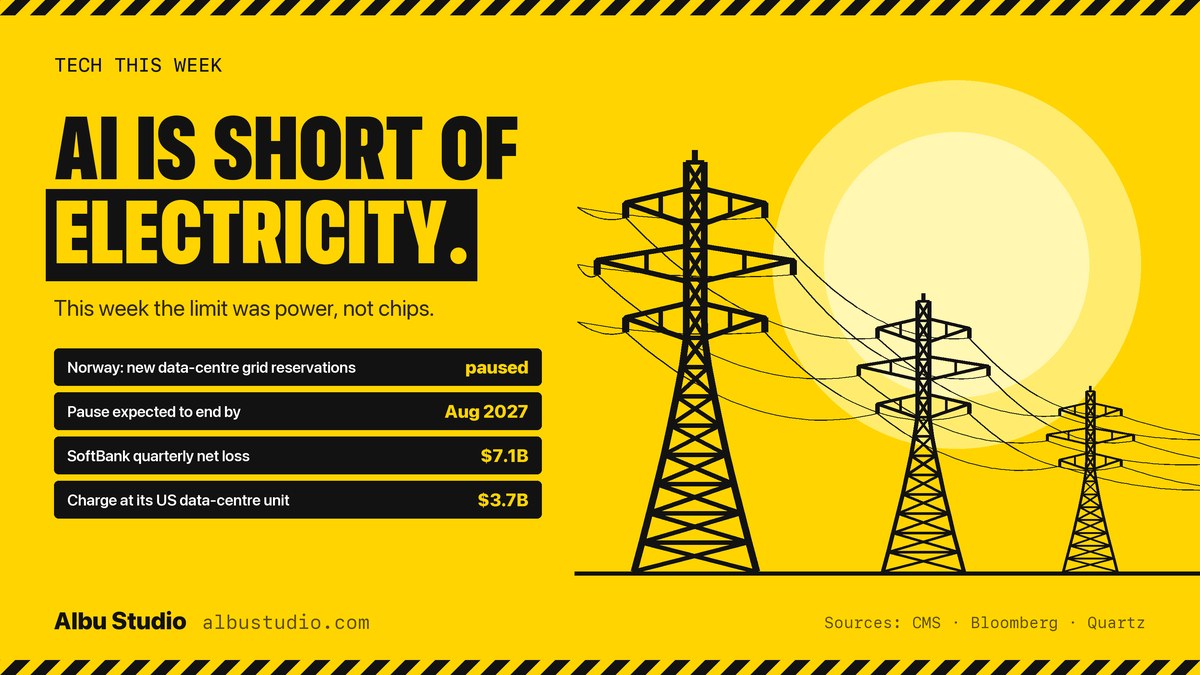
- On Monday 9 November 2026 Statnett, the company that runs Norway's power grid, stopped taking new grid reservations for data centres. The pause is temporary and is expected to end by 1 August 2027 at the latest; connections that already exist are not affected. Norway has some of the cheapest and cleanest electricity in Europe, which is exactly why so many data centres wanted to be there.
- On Tuesday 10 November SoftBank reported a quarterly net loss of about $7.1 billion, its first in almost two years. About $3.7 billion of it is a charge at its US data-centre unit, most of it advances paid for power-generation equipment the company no longer plans to use.
One story is a country saying its grid has no more room for now. The other is one of the biggest investors in AI discovering that buying power is harder than buying chips. Together they say that the limit on AI right now is electricity.
Why an app owner should care
Every AI answer that comes from the cloud is produced in a building that needs a power line, and somebody pays for that line. Today the price per request is low and still falling for many models. But the price is set by supply, and supply is now tied to how fast grids can be extended, which is measured in years. Nobody can promise what a cloud AI request will cost in 2028.
That matters most for features that run on every tap. A feature that calls a cloud model once a day per user is a small line in the budget. A feature that calls it on every keystroke is a bill that grows with your success, at a price you do not control.
What can run on the phone
Phones and laptops have become capable of far more than most apps ask of them. Both Apple and Google now ship AI models that run on the device itself, and apps can use them without sending anything to a server. Work done on the device costs you nothing per request, works without a signal, answers instantly and keeps the user's data on their own phone. As a rule of thumb:
- Good on the device: recognising text in a photo, dictation, translation of short texts, sorting and tagging, search across the user's own content, short summaries, suggestions as the user types.
- Better in the cloud: long documents, questions that need current information from the internet, complex reasoning, anything that must give the same high quality on a five-year-old phone.
How we decide, feature by feature
- Ask whether the feature needs a model at all. A good filter, a saved search or a template often does the job and never fails.
- If it needs a model, try the on-device one first. If the result is good enough, stop there.
- If it needs the cloud, call it only when the user asks for something, not in the background and not on every keystroke.
- Save results. The same question about the same data should not be paid for twice.
- Make the app useful without the AI feature. If the service is slow, expensive or down, the rest of the app still works.
- Put a number on it before building: requests per user per day, times the price, times the users you hope for. If the number is uncomfortable at ten times your current size, redesign now.
"Works offline" is also a selling point by itself. People notice an app that opens instantly in a lift, on a plane or in a village with one bar of signal, and they notice the ones that show a spinner.
What it means for a quote
When we price an app with AI in it, the running cost is part of the conversation from the first day, next to the build cost. An app that does most of its work on the device costs a little more thought at the design stage and much less every month after launch. With electricity now the scarce ingredient of AI, that trade looks better every quarter.