Businesses in ChatGPT: what a small online shop should do now
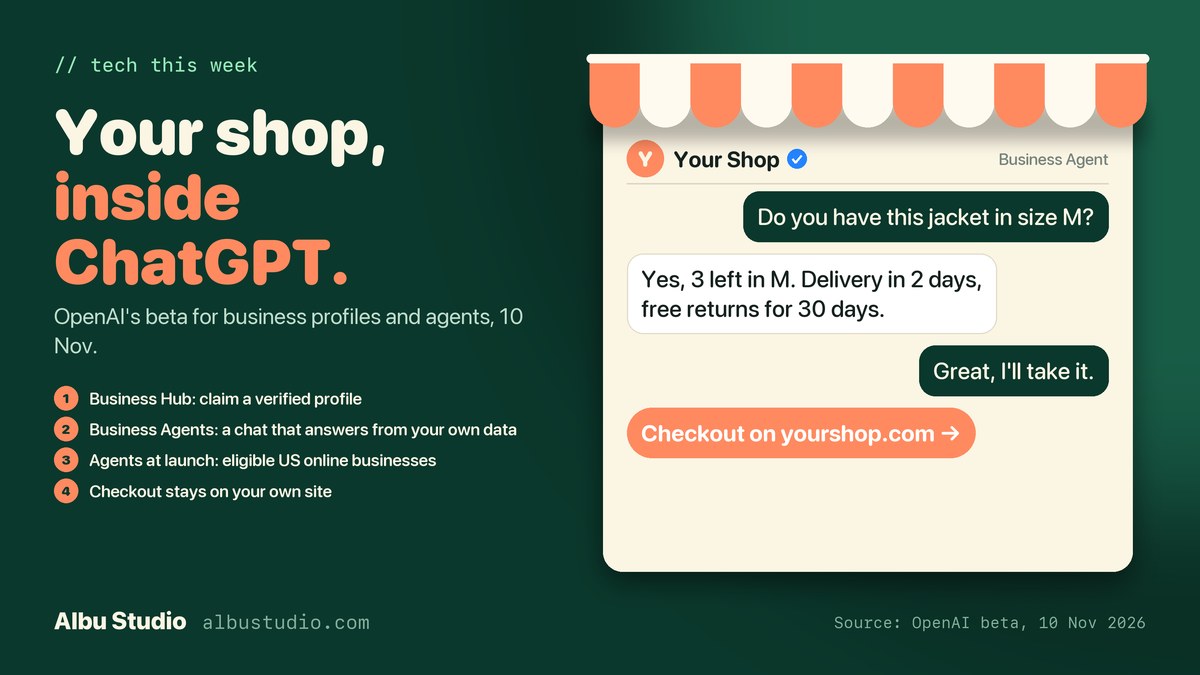
People already ask ChatGPT what to buy and where. Until this week a shop had no say in what it answered. On 10 November 2026 OpenAI opened a beta called Businesses in ChatGPT, which gives a business a profile it can claim and correct, a way to hand over its product list, and, for some US businesses, its own labelled chat agent. Here is what exists today, what a shop in Romania or Bulgaria can use, and the work that is worth doing either way.
The beta is two days old as we write, and OpenAI is changing it as it goes. The details below come from the launch coverage and from developers who went through the screens on day one. Check the Business Hub itself before you rely on any single detail.
The three parts
- Business Hub. A dashboard, at chatgpt.com/business-hub or in the ChatGPT sidebar, where the owner or an authorised representative claims the business, corrects its details and sees how ChatGPT users reach it.
- Product feeds. A verified business can give ChatGPT its product list with prices and availability, as a file or through a Shopify connection.
- Business Agents. A chat inside ChatGPT, clearly labelled as a conversation with the business, that answers customers from the product details and policies the business supplied. At launch this is limited to eligible online shops and online services in the United States.
How claiming a profile works
- Open Business Hub and find your business, or add it if it has no listing. Claiming is reported to be open to eligible businesses with a website wherever ChatGPT is available.
- Prove the business is yours. The methods reported are a code sent to the business phone or business email, a DNS TXT record on your domain, or connecting your Shopify store. You are shown only the ones that apply to you.
- Pass an identity check with ID, registration details and proof that you may act for the business. Until that is approved you cannot publish changes, connect a feed or see the statistics.
- Edit the profile: website, description, category, logo, cover photo, delivery policy and returns policy. OpenAI reviews each change before it goes live.
No fee is listed for claiming. Advertising in ChatGPT is a separate, paid product, and OpenAI says ads are labelled and do not influence the answers.
The product feed: nine fields you must fill
The feed is a file, CSV or JSON lines, that follows OpenAI's product specification. The specification has 48 fields, and nine of them are required:
item_id, title, description, url, brand, seller_name, image_url, price, availability- Title: up to 150 characters. Description: up to 5,000.
- Price is written as an amount, a space and a currency code, for example 20.00 USD.
- Availability is one of in_stock, out_of_stock, pre_order, backorder or unknown. Empty or misspelled values are rejected.
- A standard feed upload targets the United States. Other markets need OpenAI to confirm the integration first.
If you have ever prepared a feed for Google Merchant Center, this will look familiar. It is the same discipline: one row per product, every field filled, nothing left as "see description".
What a Business Agent can and cannot do
- It answers questions about your products and policies, from the information and instructions you gave it.
- It must say it is an AI, and it is shown apart from ChatGPT's own answers.
- It cannot complete a purchase, make a booking or look up a customer's order. Buying still happens on your own website.
- OpenAI reviews an agent when it is created and at every update.
What you can see afterwards
Business Hub reports, for the last 28 days, how often ChatGPT referred to your website, how many clicks went through to it, and the general topics of the answers that mentioned you. It does not show anyone's conversations. Small sites may see blanks until they pass a reporting threshold. ChatGPT also adds utm_source=chatgpt.com to the links it sends, so your own analytics can already tell you how many visitors come from it today.
What it does not do
OpenAI's own wording, as quoted in the launch coverage, is that claiming does not guarantee higher placement or sales. ChatGPT shows information about a business whether or not it is claimed, keeps using other sources, and decides by itself what to recommend. A profile and a feed make your facts available and correct. They do not buy a recommendation.
If your shop is in Romania or Bulgaria
Agents are US-only, and a standard feed targets the US. What you can do today is look for your business in Business Hub, claim the profile if you are offered it, and correct the description, delivery and returns information. That is a small job with a real effect: when someone asks an AI assistant about your shop, the answer should come from your own words and not from a five-year-old directory page.
The work that pays off whatever happens next
Every AI shopping feature, from OpenAI, Google or anyone else, reads the same raw material: your product data and your policies. Shops with clean data will be easy to recommend, and shops without it will be skipped. This is the checklist we use:
- Titles that say what the product is: brand, product type, the key attribute, size or colour. Not "Model X-200 NEW!!!".
- Descriptions that answer questions: material, dimensions, what is in the box, who it suits. Written as sentences, not keyword lists.
- A brand on every product, including your own brand on products you make.
- One clear photo on a plain background as the first image.
- Price and stock that match the website at all times. A feed that says "in stock" for a sold-out product gets a shop distrusted fast.
- A delivery page with real numbers: cost, couriers, days. And a returns page in plain words: how many days, who pays, how to start.
- The same business name, address and phone number everywhere: website footer, Google Business Profile, Facebook page, invoices.
- Check your analytics for visits with utm_source=chatgpt.com, so you know your starting point.
None of this is wasted if ChatGPT's beta changes shape, because Google Shopping, Meta catalogues and marketplace listings all reward the same things.